
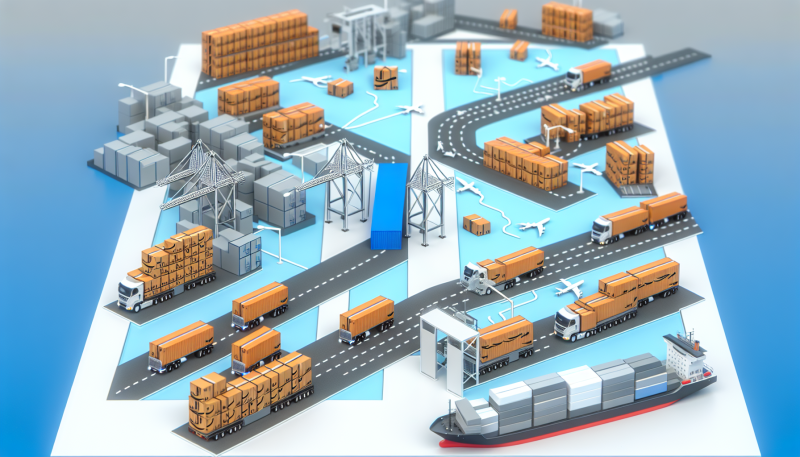
Amazon processes over 1.6 million packages daily in the United States alone, maintaining delivery speeds that competitors struggle to match. This operational excellence stems from a logistics network that integrates advanced technology, strategic infrastructure placement, and data-driven decision-making. For Amazon FBA sellers and e-commerce operators, understanding these logistics principles offers actionable insights for improving their own supply chain performance. This examination reveals how Amazon transformed delivery efficiency from a competitive advantage into an industry standard.
Amazon's Cutting-Edge Fulfillment Centers
Amazon operates over 175 fulfillment centers in North America, each strategically positioned within proximity to major metropolitan areas. This geographic distribution reduces shipping distances by 30-50% compared to centralized warehouse models, cutting both transit time and transportation costs. Fulfillment centers range from 600,000 to 1 million square feet, designed specifically for high-velocity sorting and processing.
These facilities deploy over 520,000 robotic drive units—Amazon's proprietary mobile robots that transport entire shelving pods directly to stationary workers. This inversion of traditional warehouse operations eliminates picker walking time, which typically consumes 50-60% of order fulfillment labor hours. The result: Amazon processes orders 2.5 times faster than conventional warehouses while reducing error rates to under 0.1%.
Amazon's fulfillment network employs a tiered structure: large sortable centers for standard items, specialized facilities for oversized goods, and sortation centers for regional consolidation. This segmentation optimizes handling procedures for different product categories, preventing operational bottlenecks that occur when diverse inventory types flow through identical processes.
The Role of Amazon Prime in Delivery Efficiency
Amazon Prime membership exceeds 200 million globally, creating predictable demand patterns that enable more accurate logistics planning. Prime's two-day delivery guarantee (and one-day service in major markets) requires Amazon to position inventory closer to end consumers, driving the expansion of regional fulfillment infrastructure.
Prime members generate 3-4 times more orders annually than non-members, providing Amazon with concentrated volume that justifies dedicated logistics investments. This density effect allows Amazon to achieve economies of scale in specific markets, making previously uneconomical delivery options financially viable. For instance, same-day delivery becomes cost-effective when sufficient Prime orders originate from a single metropolitan area.
The subscription model also enables Amazon to absorb individual shipping costs while maintaining profitability through membership fees. This financial structure allows operational decisions based on network efficiency rather than per-shipment margins, fundamentally changing logistics optimization calculations.
Amazon's Use of Data Analytics in Logistics
Amazon's forecasting algorithms analyze over 400 variables—including historical sales data, seasonal trends, regional preferences, search patterns, and external factors like weather—to predict demand with 95%+ accuracy for established products. This precision enables proactive inventory positioning, placing products in fulfillment centers nearest to anticipated demand before orders materialize.
The company's real-time route optimization systems process delivery vehicle locations, traffic conditions, package volumes, and delivery windows simultaneously. These algorithms recalculate optimal routes every 15-30 minutes, adapting to changing conditions throughout delivery shifts. During peak periods, this dynamic routing reduces delivery vehicle mileage by 15-20% compared to static route planning.
Amazon's inventory distribution algorithms determine which fulfillment centers should stock specific products based on regional demand probability. Popular items are distributed across multiple facilities, while slower-moving inventory concentrates in fewer locations. This graduated distribution strategy balances inventory carrying costs against delivery speed requirements, optimizing total network costs rather than individual facility metrics.
Technology Stack Behind Amazon's Warehouse Automation
Amazon's warehouse management system integrates multiple specialized technologies into a cohesive operational platform. Computer vision systems verify package contents and dimensions at multiple checkpoints, catching fulfillment errors before shipment. These systems process images at 60 frames per second, inspecting thousands of packages hourly without workflow interruption.
The company's robotic systems extend beyond mobile drive units to include robotic arms for palletizing, autonomous carts for inter-facility transport, and automated packaging machines that create custom-sized boxes. This packaging optimization reduces dimensional weight charges—a significant cost factor in carrier pricing—by 20-25% compared to standard box sizes.
Amazon's predictive maintenance algorithms monitor equipment performance across its fulfillment network, identifying potential failures before they cause downtime. Conveyor systems, sortation equipment, and robotic units transmit performance data continuously, allowing predictive models to schedule maintenance during low-volume periods. This approach has increased equipment uptime to 99.5%, minimizing the operational disruptions that cascade through logistics networks.
Real-time inventory tracking employs RFID technology and barcode scanning at every movement point, providing location accuracy within three feet for any item in the network. This granular visibility enables Amazon to fulfill orders from the optimal location even when inventory exists in multiple facilities, reducing split shipments and improving delivery speed.
Amazon's Robust Last-Mile Delivery Network
Last-mile delivery represents 53% of total shipping costs in e-commerce logistics. Amazon addresses this challenge through Amazon Logistics (AMZL), its proprietary delivery network comprising over 400,000 drivers globally. Unlike traditional carrier models, AMZL employs independent Delivery Service Partners who operate routes under Amazon's operational framework, combining contractor flexibility with centralized quality control.
Amazon Flex supplements this capacity with on-demand drivers using personal vehicles for package delivery. This gig-economy model provides surge capacity during peak periods without requiring permanent infrastructure investment. During Q4 holiday seasons, Flex drivers handle up to 30% of last-mile volume in major markets, preventing the delivery delays that plague competitors.
The company has also deployed over 3,000 Amazon Hub Locker locations and thousands of Counter pickup points in retail stores. These alternative delivery endpoints reduce failed delivery attempts—which cost carriers $15-20 per occurrence—while providing customers with flexible retrieval options. Approximately 8-10% of Amazon deliveries now utilize these pickup networks.
The Impact of Technology and Innovation
Amazon Prime Air, the company's drone delivery program, completed over 1,000 test deliveries by 2023. These unmanned aircraft systems deliver packages under five pounds to addresses within 10-mile radii of dedicated facilities. While regulatory constraints limit widespread deployment, drone delivery demonstrates Amazon's commitment to revolutionary rather than incremental logistics improvements.
Amazon Scout autonomous delivery robots operate in select neighborhoods, navigating sidewalks to deliver packages directly to customer doorsteps. These six-wheeled robots travel at walking pace, using computer vision and obstacle detection to navigate urban environments. Current deployments remain limited, but the technology addresses last-mile delivery costs in residential areas where traditional vehicles prove inefficient.
The company tests electric delivery vehicles across its network, with commitments to deploy 100,000 custom electric vans by 2030. These vehicles reduce per-mile operating costs by 40% compared to combustion engines while supporting sustainability initiatives. Electric vehicle adoption also positions Amazon advantageously as urban markets implement zero-emission delivery requirements.
Amazon Air: Expanding Delivery Horizons
Amazon Air operates over 110 dedicated cargo aircraft, providing controlled capacity for time-sensitive long-distance shipments. This air network connects major fulfillment hubs across the United States, enabling overnight inventory transfers that position products closer to customers without maintaining excess safety stock in every facility.
By controlling air transportation, Amazon eliminates dependency on commercial carrier schedules and capacity constraints. During peak seasons, commercial air cargo rates can increase 300-400%, significantly impacting delivery economics. Amazon Air maintains consistent capacity and pricing regardless of market conditions, protecting delivery speed commitments when competitors face carrier bottlenecks.
The air network includes a dedicated hub at Cincinnati/Northern Kentucky International Airport, featuring 3 million square feet of sortation capacity. This central hub enables efficient package consolidation and redistribution, functioning as the network's primary interchange point. Packages can travel between any two points in the continental United States within 24-36 hours through this hub-and-spoke model.
The Environmental Considerations of Amazon's Logistics Network
Amazon's Climate Pledge commits the company to net-zero carbon emissions by 2040, requiring fundamental changes in logistics operations. The company has ordered 100,000 electric delivery vehicles from Rivian, representing one of the largest electric vehicle deployments in commercial transportation. These vehicles began service in 2022, with full deployment scheduled through 2030.
Route optimization algorithms now incorporate carbon efficiency alongside time and cost metrics. Deliveries may consolidate to fewer trips even if individual package delivery times extend slightly, reducing total vehicle miles traveled. This multi-objective optimization approach decreased delivery vehicle emissions by 11% in 2022 while maintaining delivery speed commitments.
Packaging initiatives include the "Frustration-Free Packaging" program, which eliminates excess materials and designs packages for efficient stacking during transportation. Amazon reports that these efforts eliminated over 1.5 million tons of packaging material since 2015, reducing both environmental impact and transportation costs through improved vehicle utilization.
How FBA Sellers Can Apply Amazon's Logistics Principles
FBA sellers can leverage Amazon's logistics infrastructure by strategically positioning inventory across the fulfillment network. The Inventory Placement Service allows sellers to send inventory to specific fulfillment centers rather than accepting distributed placement. For products with concentrated regional demand, positioning inventory in target market fulfillment centers can reduce delivery times by 1-2 days even within the FBA framework.
Sellers should analyze their sales data to identify geographic demand patterns, then optimize inventory distribution accordingly. Products with national demand benefit from distributed placement across multiple fulfillment centers, while regionally popular items perform better when concentrated near their primary markets. This mirrors Amazon's own inventory positioning strategies at the product level.
For merchants managing their own logistics outside FBA, implementing tiered delivery speed offerings creates competitive advantage. Establishing partnerships with regional carriers for local deliveries while using national carriers for distant shipments replicates Amazon's multi-modal approach at smaller scale. The key principle: match logistics investment to customer delivery expectations within specific market segments.
Data-driven inventory management remains accessible to sellers of all sizes through modern inventory management software. These platforms provide demand forecasting, reorder point optimization, and inventory turnover analysis—scaled versions of Amazon's sophisticated algorithms. Sellers who implement systematic inventory management reduce stockouts by 30-50% while decreasing excess inventory carrying costs.
Conclusion: A Continual Evolution in Logistics Operations
Amazon's logistics network represents a $61.1 billion annual investment in infrastructure, technology, and innovation. This integrated system—spanning fulfillment centers, air cargo operations, delivery networks, and sophisticated software—creates competitive advantages that extend beyond delivery speed to encompass cost structure, scalability, and customer experience. For FBA sellers and e-commerce operators, Amazon's logistics principles offer a roadmap: invest in data analytics, optimize inventory positioning, leverage multiple delivery channels, and continuously test emerging technologies. While few companies can match Amazon's scale, the strategic frameworks underlying its logistics excellence apply across operations of all sizes.